Sleep Is Not the Same as Rest: What Recovery Data Can and Cannot Tell You
Sleep and rest overlap, but they are not interchangeable. Wearables can reveal useful patterns, yet a sleep score is not a diagnosis and should not be mistaken for complete readiness.
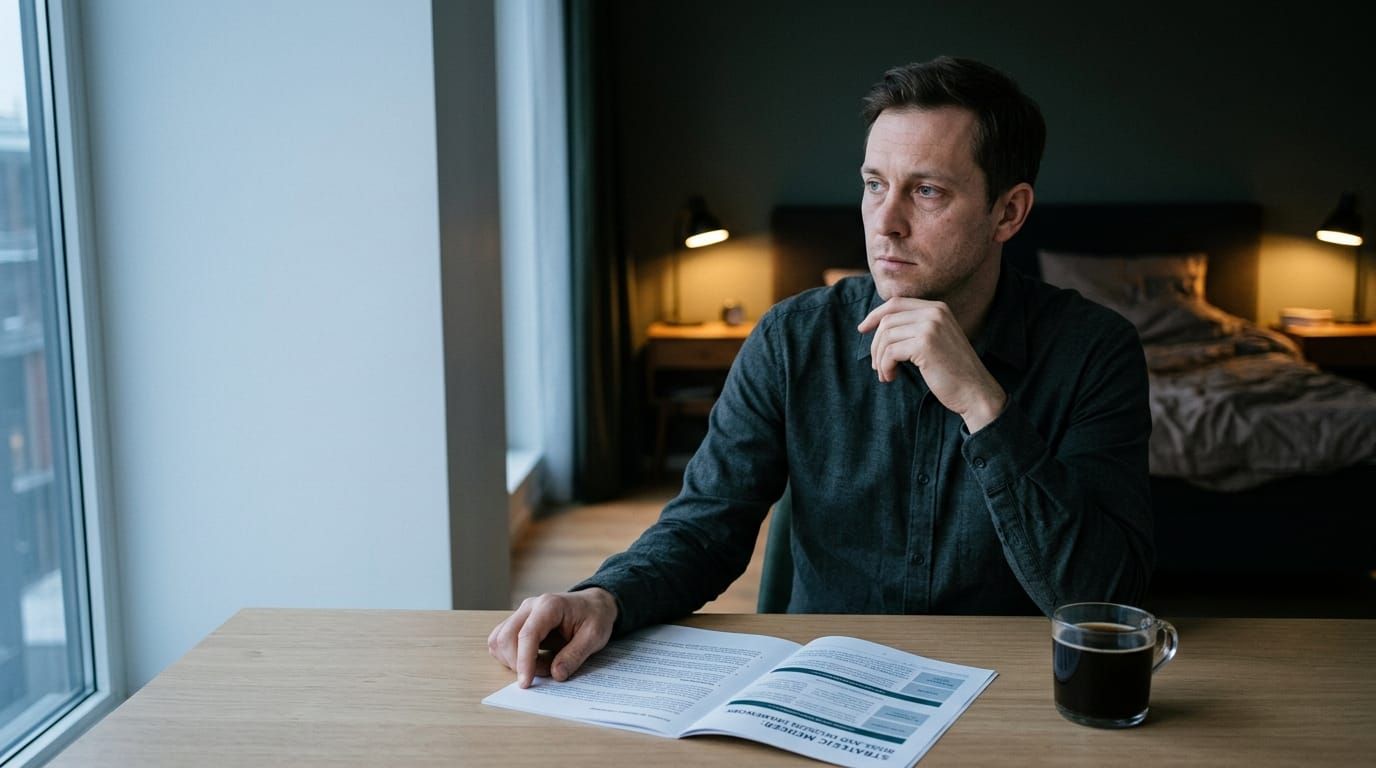
A quiet evening can be restful. It cannot substitute for sleep.
That distinction sounds obvious, but performance culture often blurs the two. A person may say they "rested" because they spent the evening on the sofa. An athlete may spend extra time in bed and assume recovery is solved. A wearable may award a high score and create confidence that the body and mind are ready. None of those signals is useless. None of them, by itself, tells us everything we need to know.
Sleep is a biological state with functions that waking rest does not reproduce. Recovery is broader still: it includes the process through which the capacities used by training, work, travel, stress and decision-making become available again. The practical mistake is to collapse all three into one number.
Sleep matters because performance depends on more than feeling tired
Sleep loss can affect vigilance, reaction time, mood, cognition and physical performance. The size and type of effect vary with the person, task, amount of sleep loss and timing. For athletes, a 2026 review of sleep, physical activity and performance concluded that sleep is an important determinant of recovery and sport-specific performance, with sleep disruption particularly relevant to tasks requiring fine motor control and sustained cognition. Athletes also face specific challenges such as early training, competition schedules and travel.
This does not mean that one short night guarantees a poor performance. People can compensate temporarily. Motivation, familiarity, caffeine, adrenaline and experience can preserve some functions while others deteriorate. The absence of obvious failure is therefore not evidence that sleep does not matter. At the same time, the evidence does not justify turning every bad decision, slow reaction or difficult mood into a sleep diagnosis.
Sleep is one contributor inside a larger system.
One reason sleep is important in performance work is that subjective adaptation can be misleading. In a classic laboratory study, Van Dongen and colleagues restricted sleep over repeated nights and found cumulative deficits in neurobehavioural performance. Participants' subjective sleepiness did not increase in parallel with every objective decline. That study has often been simplified into the claim that people who sleep six hours for two weeks become "equivalent to two days without sleep" in every meaningful sense. That is too broad.
The useful finding is more careful: repeated sleep restriction produced cumulative performance impairment on the tasks studied, while subjective perception did not track the decline perfectly. In practice, that means "I feel fine" is relevant information, but not definitive evidence that performance capacity is unchanged.
Sleep is not a single performance function
Sleep supports multiple processes, including memory, emotional regulation, metabolic function and physical restoration. Popular explanations sometimes become too mechanistic: one stage "stores" memory, another "repairs" emotion, as though each function belonged to a single isolated compartment. The science is more integrated. Different sleep stages and neural processes contribute to different forms of learning and regulation, and those relationships depend on the task being studied. Sleep also interacts with circadian timing, prior wakefulness, health and individual differences.
That complexity is not a reason to dismiss sleep science. It is a reason to avoid turning a complicated biological state into a slogan.
Wearables have made sleep visible to millions of people. That has real value. Devices can help users notice bedtime regularity, approximate sleep duration and longer-term changes in patterns. Some can provide useful longitudinal information when the person understands the limitations. But consumer sleep trackers do not measure sleep in the same way as clinical polysomnography. A 2025 meta-analysis comparing wrist-worn consumer devices with polysomnography found significant differences in total sleep time, sleep efficiency, sleep latency and wake after sleep onset across the devices studied. A 2026 systematic review and meta-analysis similarly concluded that wearable trackers should not be treated as reliable substitutes for polysomnography.
The important distinction is not "wearables are wrong". It is wearables are estimates designed for a different purpose. A trend can be useful without every minute or sleep-stage label being clinically precise.
A sleep score is not a readiness diagnosis
Many platforms convert multiple signals into a daily score. That design is convenient. It can also create false precision. A score of 82 looks more authoritative than the statement "your sleep appeared broadly similar to your recent pattern". Yet the number is produced by an algorithm combining estimates and assumptions that differ between companies and devices. The score may be useful as a prompt. It should not become the final authority on whether someone is ready to train, negotiate, compete or make a difficult decision.
If a person feels well, performs normally and has a low score, the discrepancy deserves interpretation rather than panic. If the score is high but the person is ill, unusually fatigued or functioning poorly, the score should not overrule the rest of the evidence. Performance data works best when signals are integrated rather than obeyed. One night creates a story. A pattern creates information. In performance work, I am more interested in trends than isolated scores. Has sleep duration changed over several weeks? Is the person waking more often? Has travel shifted their schedule? Do difficult training blocks coincide with deteriorating sleep? Are mood, attention or decision quality changing at the same time?
These questions do not convert coaching into medicine. They help place sleep in context. A wearable can contribute one layer of evidence. The athlete or professional's experience contributes another. Performance behaviour contributes another. Medical assessment may be required when symptoms suggest a sleep disorder or another health concern. No single layer should be asked to do every job.
Sleep hygiene helps, but it is not a complete explanation
Advice about consistent schedules, light, caffeine, alcohol, bedroom conditions and pre-sleep routines can be useful. It can also become too generic. A person may follow every standard sleep-hygiene recommendation and still struggle because of shift work, pain, anxiety, sleep apnoea, medication, caregiving, travel or a schedule that simply does not allow enough opportunity for sleep. High performers may face another problem: sleep is treated as negotiable whenever work expands.
The intervention then is not merely a better bedtime ritual. It may be workload design. If meetings repeatedly end late and training begins early, personal discipline cannot create hours that do not exist. Recovery advice should not hide structural causes. Sleep opportunity matters, but excessive time in bed is not a universal solution. The joint American Academy of Sleep Medicine and Sleep Research Society consensus recommends that healthy adults generally sleep seven or more hours per night on a regular basis for optimal health, while individual needs vary. Athletes may need additional attention to sleep because of travel, training and competition demands.
But persistent insomnia, excessive daytime sleepiness, loud snoring, breathing interruptions or other significant symptoms should not be managed through performance coaching alone. They may warrant assessment by a qualified healthcare professional or sleep specialist. The boundary is important because better sleep is a performance issue and a health issue, but they are not the same scope of practice.
Sleep extension may help when sleep opportunity is insufficient
Research in athletes has explored extending sleep opportunity when baseline sleep is restricted or inadequate. Results are encouraging in several contexts, but they are not a universal prescription. The benefit depends on the athlete, timing, sport, previous sleep and practical schedule. Napping can also support alertness and recovery in some circumstances. Timing and duration matter because longer naps can produce sleep inertia immediately after waking.
The useful question remains functional: What sleep strategy improves readiness for the actual demand without creating a new problem?
A wearable is most valuable when it helps a person notice patterns they would otherwise miss. It becomes less valuable when the score determines how the person feels before they have even checked in with their own functioning. This phenomenon has been discussed in sleep medicine under the term orthosomnia: an excessive preoccupation with achieving idealised sleep metrics that can itself complicate sleep concerns. Not every engaged wearable user develops this problem. The concept simply illustrates a broader performance principle.
Measurement should support judgement. It should not replace it.
A simple way to use sleep data responsibly is to examine three layers. Sleep: What do the available signals suggest about duration, timing, continuity and recent change? Context: What else changed — training load, illness, stress, travel, caffeine, alcohol, schedule or environment? Function: How is the person actually performing, feeling and recovering across the day? This Sleep–Context–Function check is an ALTIUS practitioner framework, not a clinical tool. It prevents a common error: treating a device estimate as if it were the whole person.
If all three layers point in the same direction, the pattern becomes more informative. If they disagree, the disagreement is useful data too.
Sleep belongs inside performance, not above it
Sleep should not become another arena for perfectionism. The goal is not a perfect score every night. It is enough high-quality sleep, on a sufficiently regular basis, to support health and the demands that matter — while recognising when a problem requires more than behavioural adjustment. A quiet evening can help recovery. A wearable can help identify trends. A coach can help connect those trends to workload and performance behaviour.
A clinician can assess suspected sleep disorders. Those roles complement one another when their boundaries are respected. Sleep is not simply rest. And a sleep score is not the person.
ALTIUS Note
The Sleep–Context–Function check is an ALTIUS practitioner framework, not a diagnostic instrument. Consumer sleep trackers can provide useful estimates and trends but should not be used as substitutes for clinical sleep assessment. Persistent or significant sleep problems should be discussed with an appropriately qualified health professional.
Research References
- Van Dongen, H. P. A., Maislin, G., Mullington, J. M., & Dinges, D. F. (2003). The cumulative cost of additional wakefulness: dose-response effects on neurobehavioral functions and sleep physiology from chronic sleep restriction and total sleep deprivation. Sleep, 26(2), 117–126. https://doi.org/10.1093/sleep/26.2.117
- Watson, N. F., et al. (2015). Recommended Amount of Sleep for a Healthy Adult: A Joint Consensus Statement of the American Academy of Sleep Medicine and Sleep Research Society. Journal of Clinical Sleep Medicine, 11(6), 591–592. https://doi.org/10.5664/jcsm.4758
- Lee, Y. J., et al. (2025). Performance of consumer wrist-worn sleep tracking devices compared to polysomnography: a meta-analysis. Journal of Clinical Sleep Medicine, 21(3), 573–582. https://doi.org/10.5664/jcsm.11460
- Agostinho, M., et al. (2026). Are Wearable Sleep-Tracking Devices Reliable Alternatives to Polysomnography? A Systematic Review and Meta-Analysis. Behavioral Sleep Medicine. https://doi.org/10.1080/15402002.2026.2673893
- Physical activity, athletic performance, and recovery: The role of sleep. (2026). PubMed PMID 41963169. https://pubmed.ncbi.nlm.nih.gov/41963169/
- Matarese, C. A., et al. (2026). Sleep Optimization in the Athlete. Neurologic Clinics. PubMed PMID 42379665. https://pubmed.ncbi.nlm.nih.gov/42379665/
Related from ALTIUS
- Recovery Is Not the Opposite of Performance. It Is Part of It — Why recovery belongs inside a performance system.
- The Burnout You Cannot See: When High Performance Hides Exhaustion — Why visible output and internal strain can diverge.
- When Rigid Thinking Is Really Sleep Debt — Why sleep loss can be one contributor to cognitive rigidity without being a diagnosis.
Further reading
Keep reading ALTIUS
Subscribe for new essays and analysis, or sign in if you already have an account.