The Moment After the Mistake
The twelve seconds Nadal spends at the towel box after a missed backhand are not rest. They are the most cognitively disciplined seconds of the entire match.
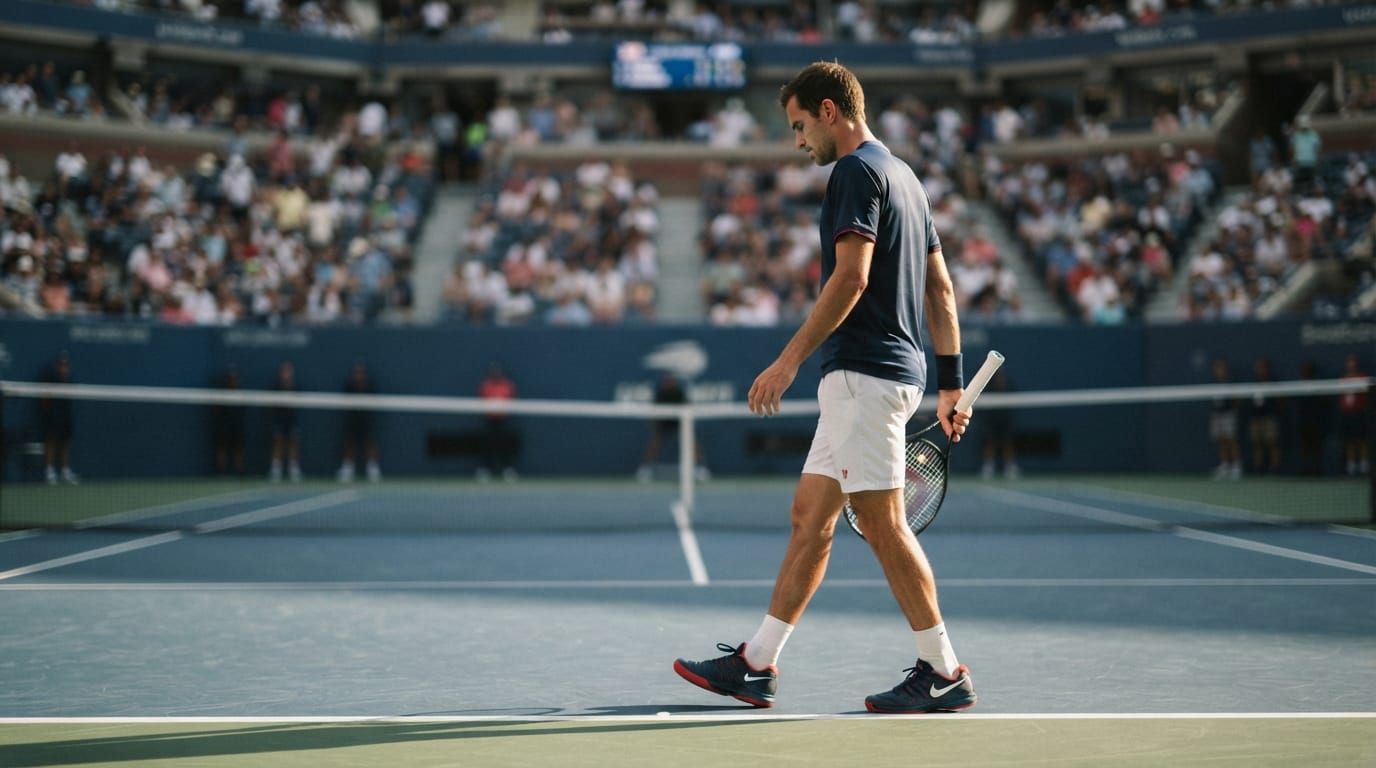
Between points in a professional tennis match, the rules allow twenty-five seconds. In that interval, Rafael Nadal does the same thing every time. He walks to the towel box. He wipes his face, his arms, the grip of the racquet. He returns to the baseline. He places two water bottles on the ground beside his chair, labels facing the court, angled in the same direction. He sweeps his foot along the baseline. He adjusts his left shoulder, then his right. He touches his nose, his left ear, his nose again, his right ear.
It looks like superstition. It is not.
It is architecture. Specifically, it is the architecture of recovery — a sequence designed to close the cognitive file on what just happened and open a new one for what comes next. Whether the previous point was a clean winner or a catastrophic unforced error, the sequence is identical. That is the point. The ritual does not vary with the quality of the outcome. It imposes a structure onto the transition that the emotional response to the outcome cannot override.
Most analysis of athletic performance focuses on what happens during the point. The more interesting question — the one with broader implications for anyone who performs under pressure — is what happens between them.
The cascade nobody trains for
In 2021, David Harris, Mark Wilson and Sam Vine at the University of Exeter published a study that should concern anyone responsible for performance in high-pressure environments. They analysed more than 650,000 points from Grand Slam tennis tournaments and asked a specific question: what happens to the probability of error after a player has just made one?
The answer was not simply that errors increase after a prior error. That would have been predictable. What Harris and his colleagues found was a multiplicative effect. The negative impact of a prior error on subsequent performance was greater when situational pressure was already high. Error and pressure did not merely add together. They amplified each other.
The mechanism is consistent with what Michael Eysenck described in attentional control theory. An error generates a negative appraisal — a rapid, often unconscious assessment of the probability of future failure. That appraisal produces anxiety. The anxiety redirects cognitive resources from the task to the threat, degrading the attentional control needed to execute the next action. Which increases the probability of another error. Which generates another negative appraisal.
This is not a bad stretch of form. It is a feedback loop — a cascade in which each error increases the likelihood of the next, particularly when the stakes are high enough for the error to carry emotional weight.
The most unsettling finding in the Exeter study was this: successful and unsuccessful players were similarly affected. The cascade is not something that happens to weak performers. It is a structural vulnerability of human cognition under pressure. The question is not whether it happens. The question is what interrupts it.
Twelve seconds that change everything
Neuroscientists have a term for what happens in the brain immediately after an error: post-error slowing. When a person makes a mistake on a cognitive task, their reaction time on the next trial increases. The brain pauses, reassesses, recalibrates. In non-athletes, this pause is pronounced — a measurable hesitation while the cognitive system processes what went wrong.
A study published in PLOS ONE comparing athletes and non-athletes on a combined flanker and stop-signal task found something striking. Post-error slowing was significant in sedentary controls but absent in both open-skill and closed-skill athletes. The athletes did not merely recover faster. Their brains showed a qualitatively different response to error — a pattern consistent with having trained, through thousands of hours of competitive pressure, a different relationship with mistakes.
This is what Nadal's twenty-five seconds accomplish. The ritual — towel, bottles, baseline, shoulders, nose, ears — is a behavioural intervention that imposes structure onto the neurological transition between error and recovery. Each action narrows attentional focus to the present. Each repetition is a signal, conscious or otherwise, that the previous point no longer exists.
Sport psychologists describe this as a "reset routine." The language understates what is actually happening. A reset routine is not simply a habit or a comfort ritual. It is a trained cognitive mechanism that interrupts the cascade — that breaks the feedback loop between error, negative appraisal, anxiety and subsequent error before it can gain momentum.
The twelve seconds Nadal spends at the towel box after a missed backhand are not rest. They are the most cognitively disciplined seconds of the entire match.
The error is not the problem
There is an important distinction buried in this research that most performance cultures miss. The error itself is rarely what degrades subsequent performance. The cognitive response to the error is what does the damage.
Rumination — the repetitive, involuntary replaying of what went wrong — is the primary mechanism of error cascading. Research on state orientation in athletes, published in the Journal of Individual Differences, found that athletes prone to rumination performed significantly worse under pressure. Not because they lacked skill. Because their cognitive resources were occupied with processing a past event rather than attending to the present one.
This maps directly onto what James Gross's work on emotion regulation would predict. The response to an error is an emotional event. How that emotion is processed determines what cognitive resources remain available for the next performance demand. An athlete who suppresses the frustration — who forces their face to remain neutral while internally replaying the mistake — is paying the same cognitive tax that Gross and Richards documented in their suppression studies. An athlete who reappraises the error — who converts the mistake into information rather than evidence of failure — preserves cognitive resources for what comes next.
Nadal's ritual is, in Gross's framework, a form of attentional deployment — one of the five emotion regulation strategies in the process model. It does not suppress the emotion. It redirects attention away from the source of the emotion before the full response develops. The bottles, the shoulders, the nose, the ears — each is an anchor that holds attention in the present, denying rumination the cognitive space it needs to begin.
This is not a tennis technique. It is a cognitive strategy with a specific neurological basis, and its relevance extends well beyond sport.
What sport knows that the boardroom does not
In elite sport, recovery architecture is an explicit, trained dimension of performance. Athletes practise reset routines. Teams design between-play protocols. Sport psychologists build error recovery into preparation as deliberately as coaches build technical skills. The interval between plays in American football, the walk between holes in golf, the break between overs in cricket — each is understood as a performance environment in its own right, not merely a gap between the moments that matter.
In almost every other high-pressure domain, this understanding is absent.
A political leader who makes a factual error during a live television interview has no reset routine. There is no twenty-five-second interval. The error is public, the stakes are immediate, and the cascade begins with no trained mechanism to interrupt it. The leader who fumbles a statistic is now simultaneously trying to recover the argument, manage the emotional response to the mistake, monitor the interviewer's reaction, and prevent the error from becoming the story. The cognitive demands compound in exactly the way the Exeter study describes — error amplifying pressure amplifying error.
In my experience, this is where most public performance failures originate. Not in the initial mistake, which is usually minor and recoverable, but in the seconds after the mistake — the unstructured interval in which rumination, self-monitoring and emotional suppression consume the cognitive resources that recovery requires.
A surgeon who nicks a vessel does not have twenty-five seconds. But the best surgical teams have trained protocols for exactly this moment — a brief verbal acknowledgement, a procedural shift, a communication sequence that externalises the recovery rather than leaving it trapped inside one person's head. The protocol serves the same function as Nadal's ritual: it interrupts the internal cascade by imposing an external structure.
A corporate executive who gives a poor answer in a board meeting has no equivalent. The culture of most boardrooms treats errors as events to be forgotten or, worse, denied. There is no trained response, no protocol, no architecture. Recovery is left to personality — to whatever internal resources the individual happens to possess. Some people recover well. Some do not. Almost nobody has been taught how.
Recovery is not resilience
There is a temptation to frame this as a question of mental toughness — to say that some people are simply more resilient than others, and that resilience explains the difference between those who recover from errors and those who spiral.
The research does not support this. What it supports is something more specific and more useful. Recovery from error is a trainable cognitive skill with identifiable components. Researchers distinguish at least three: the ability to rapidly down-regulate the emotional response to the mistake, the ability to redirect attention from the past event to the present demand, and the ability to adjust behaviour without over-correcting.
Each of these is a skill, not a trait. Nadal was not born with his between-point ritual. He built it, refined it, and made it automatic over decades of competitive play. The open-skill athletes in the post-error slowing study did not arrive at the laboratory with pre-installed neural efficiency. They developed it through thousands of hours of making errors and recovering from them under conditions that demanded recovery.
This is the distinction that matters: recovery architecture — the trained, structured system that determines how quickly and completely a person regains access to their abilities after an error. It is not the same as resilience, which implies a character quality. It is not the same as mental toughness, which implies an innate capacity to endure. It is a set of specific, learnable mechanisms that can be designed, practised and deployed.
Sport has been building recovery architecture for decades. It is one of the most sophisticated dimensions of elite athletic preparation, and one of the least transferred to other domains where performance under pressure is equally consequential.
Every training programme asks one question:
How do we prevent mistakes?
The harder question, which sport has begun to answer and most professions have not:
What happens in the seconds after the mistake is made?
The answer, it turns out, is not a matter of character. It is a matter of architecture. And architecture can be built.
ALTIUS Note
This article belongs to the ALTIUS editorial library: evidence-based essays on Human Performance, Leadership and Society.
Tags: Sport, Human Performance, Psychology
Selected Research Foundations
Harris, D. J., Wilson, M. R., & Vine, S. J. — "Psychological Pressure and Compounded Errors During Elite-Level Tennis" https://doi.org/10.1016/j.psychsport.2021.101987
Chueh, T.-Y., et al. — "The Comparisons of Inhibitory Control and Post-Error Behaviors Between Different Types of Athletes and Physically Inactive Adults" https://doi.org/10.1371/journal.pone.0256272
Beckmann, J., & Kazén, M. — "Taking Action or Thinking About It? State Orientation and Rumination Are Correlated in Athletes" https://doi.org/10.1027/1614-0001/a000281
Gross, J. J. — "Emotion Regulation in Adulthood: Timing Is Everything" https://doi.org/10.1111/1467-8721.00152
Eysenck, M. W., Derakshan, N., Santos, R., & Calvo, M. G. — "Anxiety and Cognitive Performance: Attentional Control Theory" https://doi.org/10.1037/1528-3542.7.2.336